I got the room wrong
Nobody in that room was working at being okay.
Which I couldn't explain.
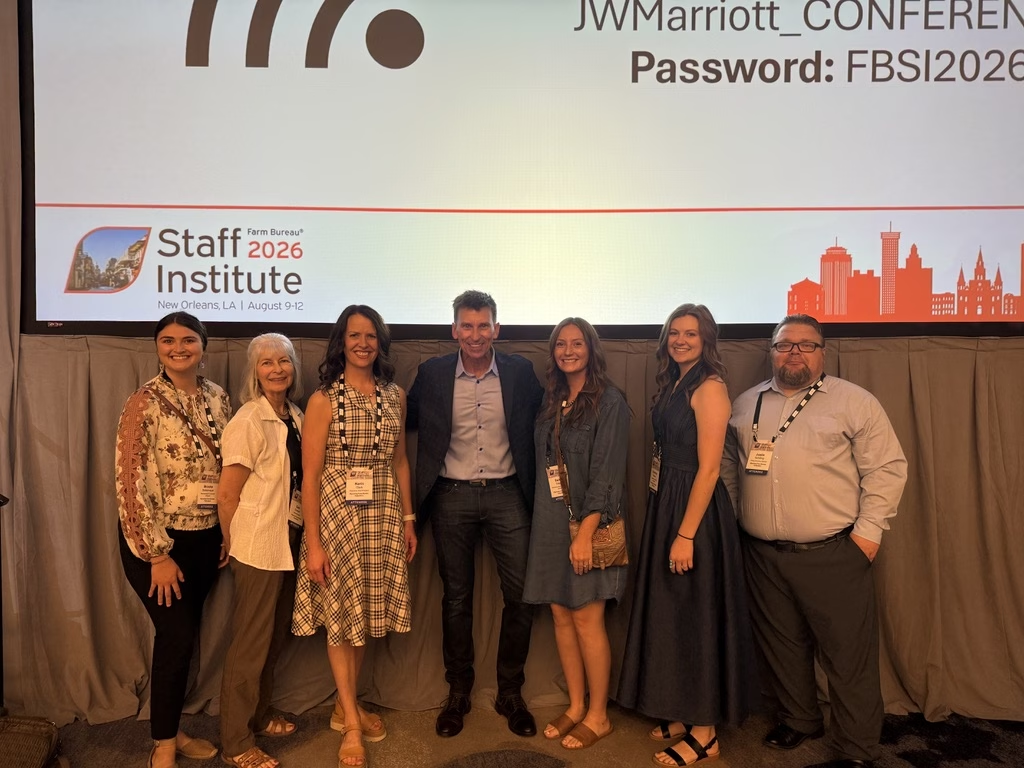
I was in New Orleans last week for the Farm Bureau Staff Institute. They bring in staff from all 51 states, general sessions all day, and I got to kick off Tuesday morning with the keynote.
Over 500 people. Biggest they've ever had.
They told me that right before I walked out. Thanks for that.
So here's what I got wrong.
If you know what's going on in agriculture right now, you know it's scary for a lot of farmers. Hard with everything happening in the industry. Farm Bureau runs a whole initiative around this called Farm State of Mind, which tells you it's not a small thing.
I figured some of that would walk in the door with everybody.
Thirty-five years of doing this and that's usually how it goes. Hard year, heavy room, and my first eight minutes are basically prying the lid off.
Didn't need eight minutes.
I don't know how to say it better than this. They're solid. Solid people.
They genuinely care about other people. They're there to learn. They're fun. They're just real.
And they're still looking for the good. In this year.

It's not the year, it's what the team does with it
I've stood in front of two groups in the same industry the same month, and one room is heavy and the other one isn't.
Which means somebody is doing something.
And most of us are doing the opposite without ever catching ourselves at it.
We call it being realistic.
So I spent the whole day watching them like a guy trying to figure out how a card trick works.
Five things.
1. They say the hard thing out loud. Once.
Not a meeting about it. Not a vent session. Somebody just names it, flat, early, in front of everybody... and then it's named, and they go do the day.
Most of us pick one of the other two doors.
Door one, we don't say it. So it sits in the room all day quietly gaining weight.
Door two, we say it constantly. Every hallway, every person, until the hard thing has slowly become the whole personality of the team.
Saying it once does something neither of those does.
It stops being the thing nobody's saying.
That's one. Four to go.
2. You work at being okay, and everybody can tell
You can usually feel a group holding it together. There's effort in it. Somebody's smiling a beat too long. Three or four people have decided the mood of the room is their personal job, and if you watch, you can see them working.
That's the mistake, and it's the one nobody thinks is a mistake. It looks like leadership. It feels like taking responsibility for the team.
What it actually does is make everybody else complicit.
Because performing fine is exhausting, and everybody can tell you're doing it. It reads fake even when the person means well. And the second one person starts, everybody else has to either join in or be the problem.
None of that was happening in New Orleans.
Nobody was working at being okay. They just were, and the ones who weren't didn't pretend otherwise.
That room let people be however they were, which sounds like a small thing and is not.
3. You stop asking, and you don't notice you stopped
Attention is the first thing pressure eats.
When people are stressed the circle shrinks until it's just them and their problem. You can watch it happen in a building. Conversations get shorter. Everybody goes heads-down. Somebody asks how you're doing and it's a formality, and both people know it's a formality.
Nobody decides to do this. That's what makes it a mistake instead of a choice.
I've never had so many people ask me a real question as I did that day. Not the conference version where somebody's waiting for their turn to talk. Actual curiosity.
These are people who genuinely care about others. That's not me being nice about a client, that's the most consistent thing I've noticed across every Farm Bureau group I've done, and I've done a bunch of them now.
A room where people are still asking about each other hasn't shrunk yet.
4. You cancel the thing that would have helped
Groups under pressure go the same direction almost every time. Cancel the offsite. Skip the training. Put your head down and grind.
It feels like focus. It's the responsible-looking option, and it's easy to defend to anybody who asks.
What it actually gets you is the same team next year, only more tired.
These folks flew in from all 51 states. In this year. To sit in general sessions all day.
That's not nothing. Travel budget in a hard stretch is the first line item somebody puts on the chopping block, and "we're sending people to a conference" is a sentence you have to defend to somebody.
They came anyway, and they weren't sleepwalking through it.
The fifth mistake is the one nobody knows they're making
5. You sit through things instead of using them
This is the one I've never watched a group get right on purpose.
Most groups receive a session. They sit politely, take a note, they're pleasant about it, and the whole thing slides right off before they get to the parking lot. That's not rudeness. That's what a full day does to people.
That afternoon I did my Gabe breakout. G.A.B.E. Gratitude, attention, behavior, environment.
They'd planned on 50 people. Over 150 signed up.
They had to keep it theater style to fit everybody, which is a great setup for a keynote and a lousy one for small group work. People turning around in their seats, half a group facing the wrong direction.
Worked anyway. Because they wanted to be in there.
I'm standing off to the side listening to the small groups go, and they're not doing the exercise. They're using it. On real stuff. In their actual jobs.
A room can decide to let something in. Most rooms don't, and I don't think most of them know it's a decision they're making.

The four things I watched my dad do
Gabe was my dad.
Dave Gabrielson. Everybody knew him as Gabe. I knew him as dad.
He spent his whole life on a farm. Never wrote a book. Never once called anything he did leadership.
But he walked into every room like the people he was talking to were the reason he came. He'd show up and everything was just better.
Gratitude, attention, behavior, environment. Four things I watched him do without either of us ever naming them.
He's been gone since 2018.
So I'm standing in the back of that overfilled theater, watching 150 people work through his questions, and it hits me that they're taking a piece of my dad home with them. To all 51 states. Most of them will never know his name.
Got emotional a lot faster than I planned on.
I went down there to give them something.
Came back with it instead.