I really like these people
I've been fortunate enough to speak for several Farm Bureau groups now, and almost every time I leave I have the same thought.
I really like these people.
New Orleans didn't exactly change my mind.
It made it worse.
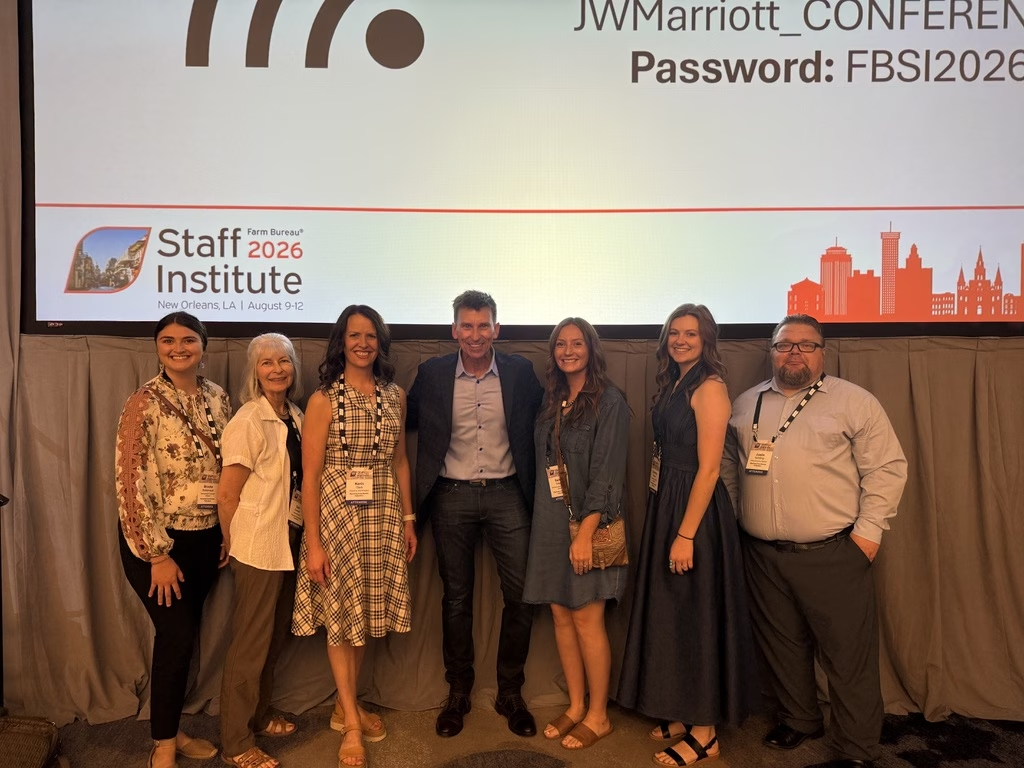
I was there for the American Farm Bureau Federation Staff Institute. More than 500 people from Farm Bureau organizations across the country came together for several days of learning, sharing ideas and getting better at the work they do.
It was the biggest Staff Institute they've ever had.
They told me that right before I walked out to open Tuesday morning with Look for the Good: It Makes Today Better.
Thanks for that.
No pressure.
But here's what I realized as I spent the day with them.
These weren't actually 500 farmers and ranchers.
These were many of the people behind the people who farm and ranch.
They work in advocacy, communications, membership, education, leadership development, outreach and a bunch of other areas.
Different titles. Different states. Different responsibilities.
But they're all connected to something bigger.
Their job, in one form or another, is to help agriculture and the people in it succeed.
And I think that's part of the reason the room stayed with me.

The hard things are real
There are real challenges in agriculture right now.
I'm not going to pretend those things aren't happening, and neither does Farm Bureau.
Farm families are dealing with economic pressure, regulations, labor issues, changing markets, uncertainty and all the other things that come with trying to make a living in an industry where you don't control nearly as much as you'd like to.
That's real.
But Look for the Good has never meant pretending the hard thing isn't there.
It means the hard thing doesn't automatically get to become everything that's there.
What you look for shows up.
And when pressure starts narrowing your attention, it changes more than your mood.
It changes how you communicate.
How you make decisions.
How you treat the next person.
How you walk into the next meeting.
How you show up for someone who may already be carrying something difficult themselves.
That's why I loved talking about this with Farm Bureau staff.
Because these are people who spend their careers showing up for other people.
Then something happened I didn't expect
The keynote connected.
And I'm trying to say that without turning this into one of those speaker posts where I tell you how wonderful I was.
Because the actual interesting part happened a few hours later.
That afternoon I was scheduled to do my G.A.B.E. breakout.
Originally, I think they were expecting around 50 people.
More than 150 signed up.
Which is wonderful news right up until you remember that somebody has to figure out where to put 100 extra human beings.
The room had to stay mostly theater-style instead of being set with nice little round tables for group work.
So now I've got people turning around in their chairs, talking over rows, forming groups wherever they can.
Not exactly how I drew it up.
But it worked.
Because there's no "table arrangments" that could prohibit a group who truly wanted to use what we were talking about.
G.A.B.E.
G.A.B.E. stands for:
Gratitude.
Attention.
Behavior.
Environment.
The breakout takes the ideas from the keynote and gives people a chance to work through them.
What are you noticing?
Where is your attention going?
How is that affecting the way you're responding?
What are you bringing into the environment around you?
But there's another reason it's called G.A.B.E.
Gabe was my dad.
Dave Gabrielson.
Most people called him Gabe. I called him Dad.
Dad grew up on a farm, and we had a hobby farm when I was a kid, but farming wasn't his career.
He worked for a propane company for years and later moved to southern Minnesota, where his work eventually transitioned into natural gas.
But if you knew my dad, his job title wasn't what you'd remember anyway.
You'd remember how hard he worked.
The guy could fix almost anything.
And if he couldn't fix it, that just meant he hadn't tinkered with it long enough yet.
He'd figure it out.
More importantly, he had a way of making people matter.
He didn't call it leadership.
He didn't have a framework.
He certainly never stood in front of 500 people explaining it.
He just lived it.
Gratitude.
Attention.
Behavior.
Environment.
Those are four things I eventually recognized in the way my dad moved through the world.
He's been gone since 2018.

Then I looked around the room
During the breakout, I stepped off to the side for a moment.
More than 150 people were working through the questions.
Some were twisted around backward in their chairs.
Some were leaning across aisles.
Not exactly the gorgeous small-group setup we'd imagined.
And I started listening.
They weren't just trying to finish an exercise.
They were talking.
Really talking.
About their jobs. About people they work with. About situations they were navigating.
About how they wanted to respond differently.
About what they could actually do when they went home.
And standing there watching them, something hit me that I hadn't expected.
These people were going home to Farm Bureau organizations all over the country.
And some little piece of my dad was going with them.
Most of those people will never know Dave Gabrielson.
They'll never know what his voice sounded like.
They'll never watch him take something apart on a workbench because apparently having three perfectly good screws left over when you put it back together is a sign of efficiency.
But maybe something he taught me about how to show up for people gets carried into a Farm Bureau office somewhere.
Maybe it finds its way into a conversation with a coworker.
Maybe that coworker takes it into a conversation with a farmer or rancher who's having a rough day.
I don't know.
But standing in that room, I realized the thing had traveled farther than I ever expected it to.
That's when I got emotional. A lot faster than I planned on.
Why I keep wanting to do these
I don't think the lesson from New Orleans is that agriculture is having a hard year and somehow these 500 people figured out how to stay positive.
That's too simple.
And that's not what Look for the Good is about anyway.
What struck me was the responsibility these people carry.
They serve people who are dealing with real problems.
They advocate for them. Communicate for them. Develop leaders. Build membership. Tell agriculture's story. Help strengthen their organizations and their communities.
And to do that well, how they show up matters too.
Their attention matters.
Their communication matters.
Their behavior matters.
The environment they create for the people around them matters.
That's human performance.
And it's one of the reasons this message seems to fit these audiences so naturally.
I've done a bunch of Farm Bureau events now.
Every time, I walk away wanting to do another one.
New Orleans may have been the strongest reminder yet.
I went down there hoping to give 500 people something they could use.
Then 150 of them showed up again that afternoon and reminded me why I love doing this in the first place.
And somewhere in the middle of all of it, my dad showed up too.
I went there to give them something.
I came home with something too.